

Table of Contents
- Why the Roast Date Matters More Than the Best-By Date
- Step 1: Check the Roast Date on the Packaging
- Step 2: Perform the Coffee Bloom Test During Brewing
- Step 3: Examine Bean Appearance and Oil Content
- Step 4: Assess Aroma and Fragrance as Freshness Indicators
- Signs of Stale Coffee Beans and When to Avoid Them
- How to Store Coffee Beans for Maximum Freshness
- Frequently Asked Questions
Last Updated: October 2, 2026
Why the Roast Date Matters More Than the Best-By Date
The roast date is your most reliable indicator of fresh roasted coffee beans. It tells you exactly when the beans were roasted, not when they'll expire.
Most coffee reaches its sweetest spot within 7-10 days after roasting. A bag labeled "best by December 2026" might have been roasted in August, long before it reaches your door.
Here's what to look for:
- Roast date printed clearly on the bag, not hidden or vague
- Recent dates preferred, ideally roasted within the last 2-3 weeks
- Single-origin beans like Avrum Coffee's Ethiopia Natural show their roast date prominently, so you know exactly what you're getting
The best-by date protects the retailer. The roast date protects your morning ritual. Always prioritize the roast date when choosing beans.
Step 1: Check the Roast Date on the Packaging
Start here. Look for a date stamped, printed, or labeled on the front or back of the bag. It should say "Roasted on," "Roast Date," or simply show a date in a clear format.
Why this matters: Fresh roasted beans peak within the first 2-3 weeks. The roast date is your baseline for freshness.
What to do:
- Scan all sides of the bag for the date
- Aim for roasts within the last 14-21 days
- If no roast date exists, move on to another bag
Avrum Coffee's single-origin options clearly display roast dates.
Step 2: Perform the Coffee Bloom Test During Brewing
The bloom test is one of the most reliable freshness checks.
The CO2 Degassing Timeline: Why Bloom Matters
During roasting, heat creates CO2 inside the bean. This CO2 remains trapped after roasting and begins a natural degassing process:
- Days 1-10 post-roast: Vigorous, aggressive bubbling. This is the optimal window for brewing.
- Days 11-21 post-roast: Steady, visible bubbling but noticeably less vigorous.
- Days 22+ post-roast: Minimal or nearly invisible bloom.
How to Perform the Bloom Test
- Grind your beans to a medium-fine consistency (similar to pour-over grind)
- Use a pour-over dripper, French press, or cupping bowl for best visibility. Avoid automatic drip machines where you can't see the bloom clearly.
- Heat water to 195-205°F (90-96°C).
- Wet all the grounds with a small amount of water, typically 2-3 times the weight of the grounds.
- Observe for 30-45 seconds. Watch the surface carefully.
-
Interpret the bloom:
- Vigorous, aggressive bubbling that rises 1-2cm above the grounds = very fresh (days 1-10)
- Steady, visible bubbling with moderate foam = fresh (days 11-21)
- Minimal bubbling or thin foam layer = aging (days 22-35)
- Little to no visible bloom = stale (35+ days)
Why Bloom Intensity Varies by Roast Level
Dark roasts produce more dramatic blooms than light roasts at the same age, because darker roasting creates more CO2.
The Bloom Test in Real Brewing
During actual brewing, the bloom phase is critical. Fresh beans bloom aggressively, which helps extract flavor compounds evenly.
Bloom Test Limitations
The bloom test is reliable but not foolproof. Grind size and water temperature affect bloom intensity.
Step 3: Examine Bean Appearance and Oil Content
Look at the beans themselves. One of the most misunderstood aspects of coffee freshness is the relationship between surface oils and age.
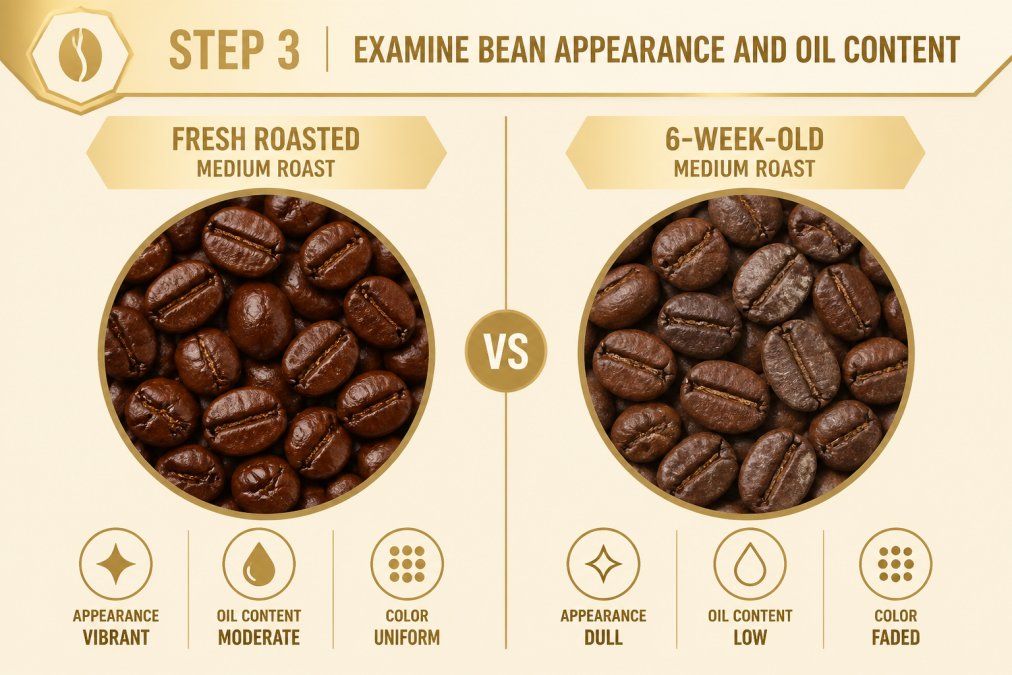
The Oil Myth: Debunked
Surface oils are determined by roast level, not freshness. Light roasts appear dry, medium roasts have light sheen, and dark roasts appear very oily, all when fresh.
What Actually Indicates Freshness in Bean Appearance:
- Color uniformity: Fresh beans show consistent color across the batch with minimal variation. Stale beans develop faded or grayish patches as oxidation dulls the surface.
- Surface sheen quality: Fresh beans have a vibrant, even sheen (on medium and dark roasts) or a clean, bright appearance (on light roasts). Stale beans develop a dull, chalky, or dusty appearance regardless of roast level.
- Bean density and structure: Freshly roasted beans appear tightly structured and dense. Over time, as moisture content changes and oxidation progresses, beans can appear slightly shriveled or less uniform in size.
- Absence of visible damage: Large visible cracks, splits, or discoloration suggest either over-roasting during the roast cycle (a roaster error) or significant age-related degradation.
The Degassing Timeline and Visual Changes
After 4-6 weeks, oxidation visibly dulls the bean surface and fades color.
Practical Visual Inspection Steps:
- Pour beans onto a white plate to see them clearly
- Note color consistency, fresh beans show uniform color with no faded areas
- Examine surface texture: vibrant or dull?
- Check for visible cracks or damage
Once you've seen truly fresh beans, the visual difference becomes unmistakable.
Step 4: Assess Aroma and Fragrance as Freshness Indicators
Smell is your second-fastest freshness check. Open the bag and take a deep breath.
What fresh coffee smells like:
- Bright and inviting
- Fruity or floral notes (depending on origin)
- Slightly sweet undertones
- Complex, multiple scent layers
What stale coffee smells like:
- Flat or one-dimensional
- Muted or faint
- Slightly musty or cardboard-like
- Lacking complexity
The fragrance is strongest in the first 2-3 weeks after roasting.
Single-origin coffees like Avrum Coffee's Tanzania (with notes of pear, floral, and jasmine) should be immediately recognizable by their aroma.
Pro tip: Grind a small amount and smell the fresh grounds.
Aroma is also your sensory evaluation tool. Beyond freshness, it tells you whether the coffee will taste good.
Signs of Stale Coffee Beans and When to Avoid Them
Stale coffee beans are past their flavor peak. They're not dangerous to drink, but they won't taste good. Learn to spot the warning signs.
Visual red flags:
- Dull, chalky appearance
- Visible cracks or splits
- Inconsistent color or faded patches
- Dusty residue inside the bag
Aroma red flags:
- Flat, muted, or faint smell
- Musty or cardboard-like notes
- No complexity or character
- Barely noticeable when you open the bag
Bloom test red flags:
- Little to no visible bubbling when water hits the grounds
- Flat surface with minimal foam
- No vigorous CO2 release
When to avoid:
- Roast date is older than 4-5 weeks
- Bag has been open for more than 2 weeks (oxidation accelerates)
- Beans show visible damage or discoloration
- The roaster won't disclose a roast date
Stale beans won't ruin your coffee, but they'll make it taste thin, bitter, or flat. You'll notice the difference immediately compared to fresh roasted beans.
Avrum Coffee's freshly roasted single-origin options are roasted to order, ensuring maximum freshness when they ship.
How to Store Coffee Beans for Maximum Freshness
Once you have fresh beans, storage determines how long they stay fresh.
The ideal storage approach:
- Airtight container, Oxygen is the enemy. Use a bag with a one-way valve (which lets CO2 escape but blocks oxygen) or an opaque airtight canister
- Cool, dark location, Heat and light accelerate oxidation. A pantry or cupboard beats a windowsill
- Away from moisture, Keep beans dry. Humidity can cause mold and affect flavor
- Room temperature, Freezing isn't necessary and can introduce condensation when thawing
Timeline for peak flavor:
- Days 1-7: Peak freshness. Maximum complexity and brightness.
- Days 8-14: Still excellent. Flavor is vibrant with minimal degradation.
- Days 15-21: Good. Noticeable but acceptable flavor loss.
- Days 22+: Drinkable but noticeably flatter and less complex.
Storage mistakes to avoid:
- Leaving the bag open after opening
- Storing in clear containers where light reaches the beans
- Keeping beans near heat sources or in direct sunlight
- Storing in the refrigerator or freezer (condensation is a problem)
- Transferring to a container that isn't airtight
The key is minimizing oxygen exposure. Every time you open the bag, oxygen enters and begins oxidizing the beans.
The difference between stale coffee and fresh roasted beans is obvious the moment you brew.
At Avrum Coffee, we roast to order and ship promptly so you receive beans at their peak.
Frequently Asked Questions
What is the ideal window to brew fresh roasted coffee beans after roasting?
Fresh roasted coffee beans reach peak flavor 7-10 days after roasting, once carbon dioxide degassing has stabilized. Brewing too soon (within 24-48 hours) can result in uneven extraction due to excess CO2 release during the bloom phase. For optimal flavor profile and body, aim to brew between days 7 and 21 after the roast date. After 3-4 weeks, oxidation begins to noticeably diminish acidity and brightness.
Do oily coffee beans mean they are fresh?
Not necessarily. Oil on the bean surface indicates higher oil content from the roasting process, which is common in medium and dark roasts. However, visible oils alone do not guarantee freshness. Fresh beans show uniform, glossy oils throughout the batch, while stale beans develop a dull, rancid appearance as oxidation occurs. Check the roast date and perform a bloom test to confirm freshness, not just surface appearance.
How long can I store coffee beans before they go stale?
Properly stored whole beans remain fresh for 3-4 weeks after roasting. Store them in an airtight container away from light, heat, and moisture to minimize oxygen exposure. Ground coffee stales faster (within 1-2 weeks) due to increased surface area. Keep beans in a cool, dark place, never in the freezer, as moisture damage occurs during thawing.
What does a good bloom look like when brewing fresh roasted coffee?
A proper bloom appears as a vigorous rise and foam on the coffee bed within 30-45 seconds of adding hot water. Fresh beans release significant carbon dioxide, creating visible bubbling and expansion. The bloom releases trapped gases and allows water to penetrate beans evenly, improving extraction. A weak or absent bloom suggests stale beans with minimal degassing activity. A strong bloom is a reliable sensory indicator of freshness and contributes to balanced flavor, body, and aftertaste.