

Table of Contents
- Why Does My Home Coffee Taste Bitter? The Four Fixable Causes
- Over-Extracted vs Under-Extracted Coffee: Which One Is Your Problem?
- Coffee Grind Size Chart for Beginners: Match Your Grind to Your Brewer
- How to Brew Better Coffee at Home: Dial In Temperature, Ratio, and Time
- How to Clean Coffee Maker to Remove Bitter Taste
- Equipment-Specific Troubleshooting: French Press, Pour Over, and Espresso
- When Bitter Coffee Is Not Your Fault: Roast Level, Stale Beans, and TDS
- Conclusion: Your Next Cup Does Not Have to Be Bitter
- Frequently Asked Questions
Last Updated: October 7, 2026
Why Does My Home Coffee Taste Bitter? The Four Fixable Causes
If your morning cup tastes harsh and dry, the answer to "why does my home coffee taste bitter" usually comes down to four fixable things: too fine a grind, water too hot, too long a brew, or a dirty brewer.
Home brewers often assume they need new equipment. Most just need to change one variable at a time.
Bitter coffee is the easiest brewing fault to fix because the cause is measurable. Below, we show you how to diagnose your cup in under two minutes, then correct it with small adjustments to grind, temperature, ratio, and cleaning.
Over-Extracted vs Under-Extracted Coffee: Which One Is Your Problem?
Telling these two apart is the most useful skill in home brewing. Taste is your instrument, no lab gear needed.
Signs You Are Over-Extracting
Over-extracted coffee tastes bitter, dry, and hollow, with a lingering finish and a chalky feel on the tongue. Milk helps a little, which is why bad cafe coffee is often drowned in it.
Common causes:
- Grind is too fine for your brewer
- Water is too hot
- Brew cycle runs too long
Signs You Are Under-Extracting
Under-extracted coffee tastes sour, thin, and salty, finishing fast, the opposite fault, needing the opposite fix. If your cup is both sour and bitter, you likely have uneven extraction, usually a cheap blade grinder producing dust and boulders.
Coffee Grind Size Chart for Beginners: Match Your Grind to Your Brewer
Grind size is the biggest lever you control and the first thing to check. Too fine a grind slows water flow and stretches contact time, pushing you into over-extraction.
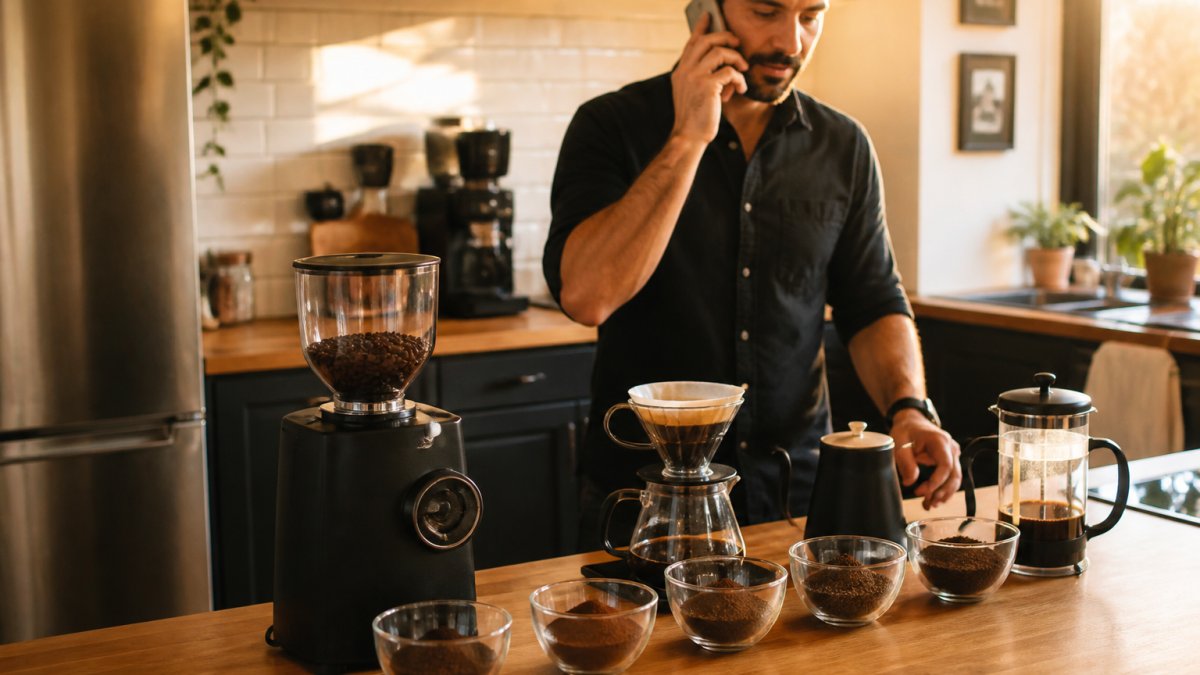
Here is a starting point for each common brewer. Treat it as a baseline, then adjust by taste.
| Brewer | Grind Size | Texture Reference | Typical Brew Time |
|---|---|---|---|
| French press | Coarse | Sea salt | 4 minutes |
| Pour over | Medium | Table salt | 2.5-3 minutes |
| Drip machine | Medium | Table salt | 4-5 minutes |
| Espresso | Fine | Powdered sugar | 25-30 seconds |
| Moka pot | Fine-medium | Fine sand | 3-4 minutes |
The texture reference matters more than the label. If your "medium" feels like flour, it is too fine for a pour over.
Visual Grind Size Guide: Calibrate by Touch and Sight
Calibrate your grinder with common kitchen references, just your fingers and good light.
Pour over and drip (medium). Like table salt, small visible grains, slight grittiness, no sharp edges.
French press (coarse). Think sea salt or raw sugar, distinct particles that hold their shape when pinched.
Moka pot (fine-medium). Between espresso and pour over, like fine sand, slightly gritty but not powdery.
Quick test: photograph grounds on a white plate and compare with reference photos online.
Why Burr Grinders Matter for Bitterness
A burr grinder gives consistent particle size, which is why it beats a blade grinder for a smoother cup. Blade grinders produce dust and boulders: the dust over-extracts bitter, the boulders under-extract sour, leaving a cup that is both, a sign of uneven extraction.
If buying pre-ground, ask for the grind matching your brewer and use it within a week or two, it stales faster because more surface area meets oxygen. For the freshest cup, grind just before brewing.
How to Brew Better Coffee at Home: Dial In Temperature, Ratio, and Time
Learning how to brew better coffee at home comes down to three numbers. Get them right and bitterness mostly disappears.
Water Temperature and Coffee-to-Water Ratio
Water should sit between 90°C and 96°C for most brewers. Boiling water scorches grounds and pulls out harsh compounds fast, so let the kettle rest 30 seconds after it clicks off.
The coffee-to-water ratio is the second number. Start with 1 gram of coffee to 15 grams of water, 20 grams of coffee for 300 grams of water, a standard mug.
Brew Time, Bloom, and Agitation by Method
Brew time controls how long water touches the grounds. Longer contact means more extraction, and past a point, bitterness.
- Bloom: Pour a small amount of water over the grounds and wait 30 seconds. This releases trapped gas so the rest of the brew extracts evenly.
- Agitation: Stir gently once at the start. Aggressive stirring speeds extraction and adds bitterness.
- Steeping: Keep French press steeping to about 4 minutes. Beyond that, the brew keeps getting harsher.
If your coffee tastes bitter after all of this, the problem is probably not your technique.
How to Clean Coffee Maker to Remove Bitter Taste
Knowing how to clean coffee maker parts properly fixes bitterness no grind adjustment can touch. Old oils and mineral buildup turn rancid and leach into your cup, so even a perfectly dialed-in brew tastes harsh through a dirty machine.
A simple monthly routine:
- Run a 1:1 mix of white vinegar and water through a full brew cycle
- Follow with two full cycles of clean water to flush the system
- Wash the carafe, filter basket, and lid in warm soapy water
For French press and pour over gear, wash the mesh filter and carafe after every use and soak them weekly in hot water with baking soda.
Equipment-Specific Troubleshooting: French Press, Pour Over, and Espresso
Each brewer fails in its own way. Here is where to look first for the most common setups, with the mechanics that cause bitterness in each.
French Press
Why it turns bitter: The metal mesh filter lets fine particles through, and they keep extracting in the cup after you plunge, so the brew gets harsher the longer it sits. Over-steeping past four minutes also pulls out bitter compounds.
Fixes:
- Grind coarser, aim for sea salt texture. If you see dust in the grounds, go coarser.
- Cap the steep at four minutes. Set a timer.
- Decant immediately after plunging. Do not leave the coffee sitting on the grounds.
Pro tip: After plunging, let the press sit 30 seconds so fines settle, then pour gently to reduce sludge in your cup.
Pour Over
Why it turns bitter: A slow drawdown is the tell. Past three and a half minutes, the bed is clogging because the grind is too fine, so water sits on the grounds too long and extracts harsh compounds.
Fixes:
- Coarsen the grind. If it still drains slowly, check your filter.
- Ensure the filter paper is properly seated and not folded. A folded filter slows flow.
- Pour in slow, concentric circles. Avoid pouring directly onto the filter paper.
- Keep total brew time between 2.5 and 3 minutes. If it runs longer, coarsen further.
Pro tip: If your pour over tastes bitter but the drawdown is fast, the problem might be water temperature. Check that your kettle is between 90°C and 96°C. Boiling water scorches the grounds.
Espresso
Why it turns bitter: Bitter espresso points to over-extraction in a narrow window. A shot running past 32 seconds at a fine grind tastes harsh almost every time, because high pressure and fine grind force water through and extract everything, including bitter compounds.
Fixes:
- Grind slightly coarser. Adjust by one step at a time.
- Shorten the shot by a second or two. Aim for a 1:2 ratio (e.g., 18g coffee in, 36g espresso out) in 25-30 seconds.
- Check your dose. Too much coffee in the basket can cause channeling and uneven extraction.
- Ensure your machine is clean. Old oils in the group head can add bitterness.
Pro tip: If your espresso tastes both bitter and sour, you likely have channeling. Use a distribution tool or WDT (Weiss Distribution Technique) to break up clumps before tamping.
Moka Pot
Why it turns bitter: Moka pots brew at higher pressure than pour over, and the water gets too hot if you preheat it or use high heat, scorching the coffee.
Fixes:
- Use preheated water (not boiling) in the base to reduce time on the stove.
- Keep the heat low. High heat causes sputtering and over-extraction.
- Remove from heat as soon as you hear the gurgle.
- Grind slightly coarser than espresso, fine sand, not powder.
Pro tip: Fill the basket level without tamping. Tamping a moka pot causes pressure buildup and bitterness.
When Bitter Coffee Is Not Your Fault: Roast Level, Stale Beans, and TDS
Sometimes you do everything right and the cup is still harsh.
Roast level changes how much bitterness is even possible. Dark roasts develop more bitter, smoky compounds before the coffee meets water.
Stale beans are the silent cause.
TDS and extraction yield are the pro-level check.
If you want a forgiving bean while you dial in your method, a balanced blend helps.
For the official guidance on water quality and brewing standards, the Specialty Coffee Association brewing standards is a useful reference. The FDA guidance on safe drinking water covers what should and should not be in your tap supply, since off-tasting water shows up directly in the cup. And if you want to understand why temperature matters so much, the USDA food science resources on heat and solubility explains how heat drives compounds into solution.
Conclusion: Your Next Cup Does Not Have to Be Bitter
Bitter coffee is solvable, and it usually takes one adjustment, not a new kitchen setup. Coarsen the grind, drop the water temperature a few degrees, shorten the brew, or clean the machine, then taste again before changing anything else.
When the fault is the bean rather than your method, the fix is freshness and roast level.
Start with a medium roast, brew it at 93°C with a 1:15 ratio, and see what your morning tastes like when the bitterness is gone.
Frequently Asked Questions
How do I get rid of bitter taste in coffee at home?
Start by coarsening your grind by one or two settings, since over-extraction is the most common cause of bitter coffee. Then check your water temperature: it should sit between 90 and 96 degrees Celsius, not a rolling boil. If the bitterness lingers, clean your brewing equipment to remove mineral buildup and old oils. Switching to freshly roasted beans with a known roast date also helps, because stale coffee tastes harsh no matter how carefully you brew it.
Does grind size affect coffee bitterness?
Yes, grind size is the single biggest lever you control. Fine grounds expose more surface area to water, so extraction happens faster and pulls out harsh compounds and tannins that read as bitter. Coarse grounds slow extraction down. If your cup tastes bitter and drying, grind coarser. If it tastes sour and thin, grind finer. Adjust in small steps and taste after each change rather than making several adjustments at once.
What brand of coffee is the least bitter?
Bitterness depends more on roast level and freshness than on brand. Lighter and medium roasts tend to taste brighter and less bitter than dark, oily roasts, and beans within a few weeks of their roast date taste smoother than stale ones. Avrum Coffee's Ethiopia Natural, a medium-light single origin with milk chocolate and caramel notes, and the Brazil Santos, a smooth medium roast with cocoa notes, are both built for a gentle, low-bitterness cup.
Is it safe to drink bitter coffee?
Bitter coffee is not dangerous, but it usually signals over-extraction, stale beans, or dirty equipment rather than a health issue. The bitterness comes from caffeine and from compounds like tannins that dissolve late in the brew cycle. If your coffee suddenly tastes bitter when it never did before, check your grinder setting, your water, and whether your beans have gone stale. Fixing those variables improves flavor without any safety concern.
Ready to fix your morning cup for good? Explore the Avrum Coffee and Tea eStore and find the roast that suits how you brew.