

Last Updated: October 30, 2026
Quick Summary
To adjust coffee grind size for pour over, lock your ratio and water temperature first, then move the grinder one small step at a time. Finer grinds extract more and taste bitter when overdone, while coarser grinds taste sour and thin, so use taste and drawdown time to find the balance. Learning how to adjust coffee grind size for pour over is one of the fastest upgrades you can make at home.
- Grind size controls how fast water extracts flavor from the coffee.
- Lock your coffee-to-water ratio before changing the grind so your tests stay fair.
- Too fine tastes bitter and dry; too coarse tastes sour and thin.
- Change the grinder by one small step, then compare two cups side by side.
- Dial in from a medium-fine starting point, since settings differ between grinders and brewers.
Table of Contents
- Pour Over Coffee Grind Size Chart: Where to Start
- How to Tell If Your Coffee Grind Is Too Fine or Too Coarse
- Pour Over Brewing Time: Reading Drawdown as a Diagnostic
- Coffee-to-Water Ratio for Pour Over and Why It Matters When You Adjust
- A Controlled Workflow for Adjusting Grind Size
- Your Next Brew: Dialing In With Avrum Coffee
- Frequently Asked Questions
Most people blame the beans when their pour over tastes bitter or sour. The grind is often the real culprit. Grind size controls how fast water pulls flavor out of the coffee. Get it wrong, and even a great single-origin bean can taste harsh or hollow. Learning how to adjust coffee grind size for pour over is one of the fastest upgrades you can make at home.
Extraction is the process of dissolving flavor compounds from ground coffee into water. Finer grinds have more surface area, so they extract faster and more fully. Coarser grinds extract slower and more lightly. Your job is to find the setting where the flavor balances out.
- Too fine: water sits too long, pulling out bitter, dry notes
- Too coarse: water rushes through, leaving sour, thin notes
- Just right: sweetness, body, and clarity come through together
Grind size is the lever you control most directly. Brew ratio and water temperature matter too, but grind gives you the biggest change for the least effort.
Pour Over Coffee Grind Size Chart: Where to Start
Many pour over brewers find a medium-fine grind, roughly the texture of fine sand, a useful starting point. It is not a fixed rule. Lighter roasts often need a slightly finer setting, while darker roasts usually taste best a notch coarser.
Think of a grind chart as a starting map, not a finish line. Use it to find your first brew, then adjust from there based on taste.
Watch out: switching grinders or dripper types can shift the right setting by a full step. Never assume a number from one setup will carry over to another.
How to Tell If Your Coffee Grind Is Too Fine or Too Coarse
Taste is your best diagnostic tool, but taste alone is ambiguous. If you need a quick fix for bitterness, start with the signals below.
Start with texture, not numbers. Grind settings are grinder-specific, so use a physical benchmark before you touch the dial. A medium-fine pour-over grind should feel like fine sand or table salt between your fingers, with a small percentage of powdery fines.
Read the cup in layers. Instead of asking "is it sour or bitter," ask where the flavor sits:
- Under-extracted (grind too coarse or brew too fast): the front of the sip is sharp and acidic, the middle is hollow, and the finish drops off quickly. Think lemon pith rather than bright fruit.
- Over-extracted (grind too fine or brew too slow): the front is muted, the middle turns woody or drying, and the finish lingers with a chalky or tea-like astringency.
- Balanced: acidity and sweetness arrive together, the body feels round rather than thin or syrupy, and the finish fades cleanly.
Use a two-cup comparison, not a single brew. Brew one cup at your current setting, then change the grind by one small increment and brew a second cup immediately. Taste them side by side while both are still warm.
Match the diagnosis to your brewer. A cone dripper like a V60 exaggerates grind differences because the water column and paper filter create a fast, uneven flow. A flat-bottom brewer like a Kalita Wave or Fellow Stagg is more forgiving and may need a slightly finer grind to reach the same extraction. If you switch brewers, re-dial from scratch rather than carrying over a setting.
Check bean age before you blame the grind. Very fresh coffee releases carbon dioxide and can slow drawdown, while older coffee can taste flatter regardless of adjustment.
Pour Over Brewing Time: Reading Drawdown as a Diagnostic
Drawdown time is how long the water takes to pass through the coffee bed after your final pour. It is a useful signal, but it is not a grind-size readout on its own.
Set a baseline first. For a 15 g dose at a 1:16 ratio (240 g water), most medium-fine pour-overs finish draining somewhere between 2:30 and 3:30 total brew time, with the final drawdown taking roughly 30-60 seconds after the last pour.
If the drawdown is fast (under about 2:00 total):
- Check your pour. If you dumped the water in one aggressive pour, the bed never formed evenly and water channeled through. Slow down and pour in pulses.
- Check the filter. A filter that is too thin or not rinsed can let water pass faster than expected. Rinse the paper and seat it fully against the dripper wall.
- Check the dose. A small dose with a wide brewer has a shallow bed that drains quickly. Increase the dose before you go finer.
- Only then go finer. Move one or two small steps finer and brew again at the same dose and pour schedule.
If the drawdown is slow (over about 4:00 total):
- Check for clogging. Fine particles migrate to the bottom of the bed and block the filter. If the bed looks muddy and the water pools on top, the grind is likely too fine or your grinder is producing too many fines.
- Check your agitation. Stirring or swirling aggressively pushes fines downward and stalls the drain. Ease off the swirl and see if the time normalizes.
- Check bean freshness. Very fresh coffee off-gasses and can slow the bed. Let the beans rest a few days and retest.
- Check the filter. Some paper filters clog more readily than others, and a filter that does not fit the dripper can seal against the wall and restrict flow.
- Only then go coarser. Move one or two steps coarser and keep the pour schedule identical.
Separate taste from time. A fast brew that tastes sweet and balanced is not a problem, even if it finishes at 2:15. A slow brew that tastes clean and sweet is also fine. Time is a warning light, not a verdict. The cup decides whether you actually need to adjust the grind.
Brewer-specific drawdown expectations. Cone drippers with a single large hole, such as a V60, tend to drain faster and are more sensitive to grind and pour technique. Flat-bottom drippers with multiple small holes, such as a Kalita Wave, drain more evenly and often run slower at the same grind.
The article gives these drawdown benchmarks and the matching fixes, summarised below so you can check your brew quickly.
| Drawdown signal | Likely cause | First fix |
|---|---|---|
| Under about 2:00 total | Pour too aggressive, filter not seated, dose too small | Pour in pulses, seat filter, raise dose before going finer |
| Over about 4:00 total | Fines clogging the bed, aggressive swirling, very fresh beans | Ease off agitation, rest beans a few days, then go coarser |
| 2:30 to 3:30 total (15 g, 1:16) | Typical medium-fine baseline | Use as a starting range, not a fixed target |
| 30 to 60 s after last pour | Typical final drawdown | Compare only at the same dose and brewer |
Coffee-to-Water Ratio for Pour Over and Why It Matters When You Adjust
The coffee-to-water ratio controls how concentrated your cup is. A common starting point is 1:16, meaning about 16 grams of water for every gram of coffee. Some brewers prefer 1:15 for a stronger cup or 1:17 for something lighter.
Change the ratio and the grind together, and the results become hard to read. Lock in your ratio first, then adjust only the grind. This keeps your tests fair.
Light roasts can benefit from a slightly higher ratio so the cup does not taste thin. Dark roasts may need a lower ratio to avoid heaviness.
A Controlled Workflow for Adjusting Grind Size
Random tweaks waste coffee and make it hard to learn. Use this simple workflow instead:
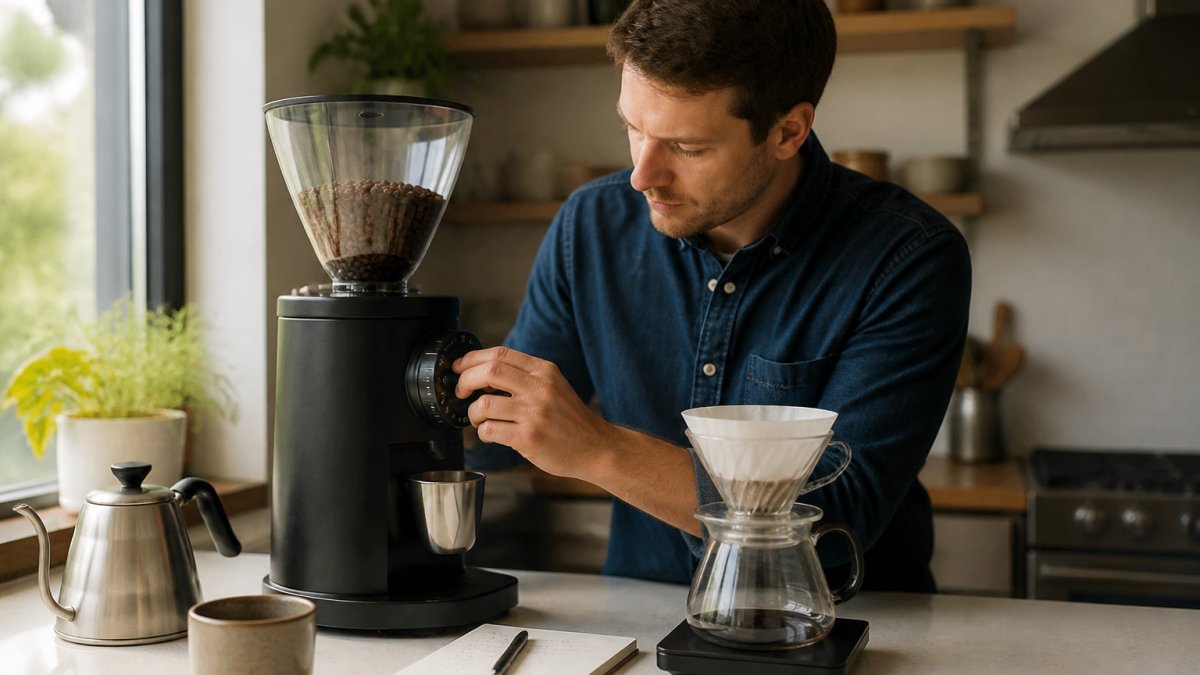
- Set your ratio, water temperature, and total brew time, then keep them fixed.
- Start at a medium-fine grind and brew one cup.
- Note the drawdown time and what you taste.
- Move the grinder one small step finer or coarser.
- Brew again and compare the two cups side by side.
- Keep the setting that tastes most balanced, and write it down.
A notebook or phone note with your grinder setting, bean, and tasting notes will save you hours. Store your beans in an airtight container away from heat and light to keep their flavor steady between tests.
Watch out: a dirty burr grinder can give uneven particles, which causes both bitter and sour notes in the same cup. Clean it regularly so your adjustments actually mean something.
Your Next Brew: Dialing In With Avrum Coffee
Once you have your grind dialed in, a good bean makes the difference you can taste. Our Ethiopia Natural is a medium-light roast with milk chocolate, fruity, and caramel notes, grown by smallholder farmers in the Sidama Zone. Our Colombia is a medium roast with dried orange, berry, and chocolate notes. Both are single origin.
Browse our full range of single-origin coffees and find the one that fits your palate. You can also read our guide on how to brew better coffee at home to build a routine around your new grind setting.
Frequently Asked Questions
How much coffee grounds do I need for a 12 oz pour over?
A common starting point is a ratio of about 1:16, meaning roughly 20 grams of ground coffee for 320 grams of water, which is close to a 12 oz (about 355 ml) cup once you account for the cup you are filling. Start there, taste the result, and adjust grind size before changing the amount of coffee. Changing the dose too early makes it hard to tell whether the grind or the ratio caused the flavor you are tasting. Once you find a grind and ratio you like, weigh both every time so your results stay repeatable.
How can you tell if your coffee grind is too fine or too coarse?
Taste is the most reliable signal. A cup that tastes sour, thin or weak usually points to under-extraction, which often means the grind is too coarse, though a slow or rushed brew can also cause it. A cup that tastes bitter, harsh or dry usually points to over-extraction, typically from a grind that is too fine. Check brew time too: if water drains very slowly and the bed looks clogged, the grind is probably too fine, while a drawdown that finishes in well under two minutes often means it is too coarse.
What should you do if your pour over drains too slowly?
A very slow drawdown usually means the grind is too fine for your filter and brewer, or that fine particles are clogging the bed. Move to a slightly coarser setting, one step at a time, and rerun the brew with everything else unchanged. Also check that your grinder is producing a consistent particle size, since a large number of fines can slow flow even when the average setting looks right. Make one change per brew so you can see exactly what improved the flow.
How should you adjust grind size if your pour over tastes sour?
Sourness is usually a sign of under-extraction, so the first adjustment is to grind finer, one small step at a time. Keep the water temperature, coffee dose and total brew time the same while you test. If the cup becomes balanced but a little harsh after going finer, you may have moved too far, so return to the previous setting and check whether your brew time or ratio needs a smaller correction instead.
Start with one bean, one ratio, and one grind setting. Change only one thing at a time, and your cup will get better with every brew.
